Sunday

Suffer The Children

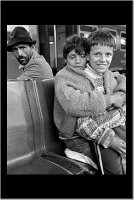
As you cross the border from Hungary into Western Romania, the noticeable differences are instantaneous. The lights, when there are any, are much dimmer, there are never any children playing, and when you do see children, they're most often huddled in the train station trying to find warmth against the walls.
It's a stark contrast from all I see at home, or from what I saw during my recent visit to America. And whenever I'm at home, our family rituals include warm embraces, playing games, or making biscuits or cakes in the kitchen together. I'm not suggesting a Currier and Ives Christmas card scene, but it's certainly an image of warmth and security.

Interestingly, there's a controversial thesis by French historian Philippe Ariès , that claims my schmaltzy attitude towards my children couldn't really have existed until the seventeenth century. Aries argues that because child mortality rates were so high, parents were not able to make the sort of emotional investment that we do in our children. Until the early modern period, children were simply adults waiting to happen.

All of which suggests a rather different take on Jesus' claim that unless we become like children, we will never enter the Kingdom of Heaven. Unfortunately, most of the time, Christians over-sentimentalise the role of children in the New Testament. It easily becomes cloying chocolate-box stuff: Jesus praises children because they are wide-eyed, innocent and trusting - a perfect analogy for faith. Well, I have difficulty swallowing that image.

Aries tips us off to the insight that children play an important role in the teachings of Jesus because they were nobodies. Life was too tough to waste love on a child who might not survive - so children became insignificant, marginalised, and terribly vulnerable. This then, is the unsettling message of what Christians are called to become if they want to find the Kingdom of Heaven. They are called to side with the nonentities and the defenceless, not with the cute and cuddly. After all, that's the real message of Christmas: the creator of Heaven and earth gets born as a pathetic child by a disgraced mother in a grotty shed.

In countries where its people have been victims of tyranny and manipulation it is difficult to get that first foothold in the rung to climb from deep within the abyss. Most of the children are unable to communicate their needs and therefore remain victims of predator adults or of those fortunate enough to be picked first. And for others, their perception of safety comes from the warmth they find with other homeless children, deep within the bowels of earth, among the steam pipes that criss-cross the city.

As we face what meteorologists claim will be one of the coldest winters in two decades, perhaps it's time for us to forget the cringe-making kitsch of the Jesus 'friend-of-little-children' image we so conveniently create for ourselves. When Jesus spoke of the kingdom belonging to children, it was to children such as these.
Ever-watching Father: we pray for the suffering children whom we do not see. We know that Your eyes see their tears, that Your heart knows their sorrow, that Your hands can reach them now. We ask that You send friends for the lonely, food for the hungry, medicine for the sick, saviours for the enslaved, and rescue for the perishing. Grant us the wisdom to do our part, to leave our comforts behind and share our possessions. Lend them our voice, give them our food and love them with more than prayers. We ask this in the name of Your own child – Christ Jesus. Amen.


Labels: , , , , ,

Monday

When Are U-Turns Right?

One of Prime Minister Margaret Thatcher’s most memorable quotes is ‘You turn. The Lady’s not for turning!’ It was comments such as this that earned her the moniker ‘Iron Lady.’

Some may vacillate, hem and haw, or be wishy-washy about their views. But Good ole Margaret ruled her opinions and views with an iron fist and fierce determination. Once she formed an opinion, she was never to revisit it.

Admirable qualities, one might say. Indeed. However, what happens when an individual or group takes such a stance and later learns they were mistaken? We read in the news where technology has now proven that people who were convicted for committing crimes are now being exonerated. Unfortunately, what if their punishment was death? What do we do in those instances? Shrug our shoulders and say ‘ doesn’t matter, I’m not changing my mind?’

Unfortunately, human nature – that determination to be part of the ‘winning team’ encourages us to perceive people who change their minds as weak or as failures. And in some arenas there are those, who despite the evidence, continue to promote their own dogma, regardless of its inaccuracies and the toll it can take on others. It happens each and every Sunday when ministers misinterpret passages from the Bible, or use those passages, however inappropriately, to justify their points.

Whatever way you look at it, repentance, or making a moral or spiritual U-turn, isn't necessarily a sign of weakness. Indeed, in the right circumstances it can be a sign of true strength. Isn’t that the point of democracy versus, say, a dictatorship?


Just as with millions of others, I watched the debate between Joe Biden and Sarah Palin. They each had an agenda which prohibited the world from really seeing who they are. Nor, in my opinion, did they really do anything to help their presidential candidates.

All too often we expect our leaders to be godlike in their ability to know everything. Yet in most religions, doubt, discovery, and growth are parts of the very nature of being divine.

Take, for example, the humble pie that Jesus had to eat when a woman proved Him short sighted and limited in His vision of His ministry. The story is told in the Gospels of Matthew and Mark and involves a very persistent woman, who was not Jewish, but a Gentile.

She comes begging Jesus to heal her daughter, and receives the rather callous - and in fact, one could argue, narrow-minded - statement that He has come only for the people of Israel. Thus He tries to dismiss this woman.

But she is made of stern stuff and implores Him again asking Him to help her daughter. Jesus compounds His uncompromising stance on a matter of principle - which is probably how today's media would report it - and says even more brusquely, that it is unfair to take the food of the children (meaning the Jews) and throw it to the dogs (meaning the Gentiles)!

Now comes the moment of revelation. Jesus is once again confronted by the woman who says, ‘Ah yes, Lord, but even the dogs are allowed to eat the scraps that fall from their master's table.’

This is the point at which, were this being reported in some of our more aggressive newspapers, we would have the headline ‘Messiah does a U-Turn’ or ‘Jesus forced to compromise.’ Because Jesus, clearly humbled by this, is suddenly presented with a far bigger picture of what He is here to do. His limited vision is expanded to encompass all people and He heals her daughter. In other words He changes His mind and grows.

Perhaps this message has been too simplistic for us to pick up on it time after time. Perhaps the Apostles are trying to tell us that uncertainty and growth are completely acceptable and part of our own spiritual growth. Perhaps, through these words, they are encouraging us to grow and not become transfixed in our own interpretation of the Bible and the world around us.

If making U-turns, uncertainty, compromise, expanding one’s vision, and changing attitudes is good enough for Christ, then perhaps it ought to be good enough for the rest of us. Instead of seeing a change of mind as a weakness, perhaps we can see it as being just a little bit divine and more Christ-like instead
.

.

.

Labels: , , , , ,

Wednesday

The Cost of Debt

Here we are at the springboard of a new year. And the first news headlines are about our prime minister’s concerns regarding the global credit crisis and steering our nation on a stable course through the financial turbulence.

At this time of year money figures particularly highly in everyone’s thoughts. Those recovering from hangovers may find their headaches intensify as depressing bank statements, credit card demands, and mortgage notices plummet through the letterbox.

But whether it’s your personal bank statement or international financial woes, money represents energy. It can flow for good, raising living standards and generating prosperity, or for ill, skewing the global economy with imbalances and mushrooming debt, making wars, and damaging lives.

But then it always has. In the Bible - rather more abundant with good financial advice than is generally believed - the slavery which formed the background to the Hebrews’ Exodus from Egypt arose not from invasion but from debt, as Joseph’s starving brothers offered to sell themselves to Pharaoh. A horror of debt threads through the Old Testament as a result.

In today’s thriving western world, slavery is much more subtle. We laughingly say we are wage slaves, toiling to pay the mortgage - a perfectly reasonable means of getting on the property ladder.

But when debt is allowed to balloon unchecked and become the norm, as it has for many this Christmas, it enslaves and enfeebles us, just as it did Joseph’s desperate brothers, robbing us of self confidence, and threatening the well-being of our families, as we work all the hours God sends to service the repayments.

Some fall prey to the idiocy of using high-interest credit cards just to buy the week’s groceries, and some, Heaven forbid, even use the card for their exorbitantly priced, but socially important daily Starbucks. It’s no wonder that relationships become strained as couples scramble between maintaining their ever-important ‘image’ of success and simply trying to exist from day-to-day.

As we look forward to the challenge and promise of a New Year, let’s ask ourselves whether our debt ridden consumer lifestyle is little more than the modern equivalent of the Romans’ bread and circuses? Working off our debts makes us too tired and busy to question decisions made by our political leaders or fight injustices in society. Debt and the goodies it buys, keeps us quiet and so further impoverishes our civic life and our collective well-being.

So let us dare to audit the effect of debt on our lives, and yes, its effect on our spiritual lives too. Most of us can’t cut up the credit cards at once, nor pay off our mortgage , but at least let’s start to question the hidden price of our spending, and why we think it so necessary?

Why should we let debt undermine our lives in such a fashion, only to become bereft of our spiritual contentment?

.

Loving Father, help us to recognise our purpose in life and pursue that purpose with strength and courage. Help us to fulfil our needs more simply and our prosperity through our spiritual wealth rather than mere tokens. And throughout this year, help us to recognise what matters most, through those we love and those who love us. We ask this in Your name. Amen

.

Labels: , , , , , ,

Thursday

When Traditions Become Weights

Being a parent to teenagers can provide a cornucopia of lessons. As adults we struggle to instil our personal values, traditions, and morals. And at the same time, we watch our children strive to develop their own.

My daughter is the epitome of neatness and regeneration, while my son tends to take a more ‘relaxed’ approach to hanging up his clothes, discarding old things, and keeping his room generally tidy. Mary is adept at discarding things when they have reached their natural cycle of use and her 'Dad-management' skills have often turned to ensuring that I adhere to a similar cycle.

A few days ago I was rather confusedly looking around the bathroom in search of my nailbrush. Surely it had fallen to the floor for it was nowhere to be found. It was a few seconds until my eyes accepted the fact that there was actually a new nailbrush sitting on the side of the tub. But my old friend of a nailbrush, that had been with us for many years, was nowhere to be found. I had a nostalgic fondness for my trusty old Fuller Brush, but it was so old and worn that the bristles had turned over the edges.

I had to agree, a new one was not only in order, but a lovely and functional gesture on the part of my daughter. But I did feel a slight sense of anticipatory panic rise as I stared at my pair of hopelessly worn jeans, with no less than four different patches, hanging on the back of the door. I felt my pulse race at the thought of having them also disappear in a fit of teenage practicality.

OK twist my arm, I admit it. I’m a hoarder. Mary is a regenerator. And I have come to see that whilst carrying baggage around from the past may be comforting, it may not be practical or convenient. And this leads on to something more important.

Tradition is a wonderful thing. However, too much tradition can be restricting. You cannot have the benefits of what is new and effective and pleasing until you let go of the past.

The German theologian Paul Tillich wrote 'Whether we observe the growth of a living cell, or of a human soul, or of an historical period, we see that growth is gain and loss at the same time; it is both fulfilment and sacrifice.'

There is a dilemma here for the church and any institution, which treasures the past and sees that as an absolute to be preserved at any cost. Sure we look to our faith as security in the turbulence of life. But if we remain at anchor, we'll never experience the challenge of the open sea, never find the excitement of new discovery.


Heavenly Father, You set in process the flow of life. Help us to treasure what is useful in our inheritance, but give us courage to let go of weights that tie us to the past, so that we may embrace the future to which You are leading us. Amen


Faith is Not a Crutch For Living

Labels: , , , , , , ,

Friday

Tre Ore, The Three Hours

LinkTre Ore, the ‘Three Hours’ is the name of the solemn service we attend now, this Good Friday, from noon until 3pm. During this time we meditate on the Seven Last Words of Christ, the seven utterances Jesus delivered from the cross, which are selected from the Four Gospels:

1. ‘Father, forgive them, for they know not what they do.’
2. ‘Truly I say unto you, today you will be with me in Paradise.’
3. ‘Woman, behold your son! ... Behold, your Mother.’
4. ‘My God, my God, why hast Thou forsaken me?’
5. ‘I thirst.’
6. ‘It is finished.’ (Tetelestai or
τετέλεσται)
7. ‘Father, into Thy hands I commend my spirit.’

 
Cursed, beaten and forced to carry His own cross, Christ’s crucifixion on ‘Good Friday’, is the blackest day in Christian history.

There are many opinions about the origins of the term Good Friday. Some scholars argue that the word ‘Good’ is an abbreviation of ‘God.’ And early Christians commemorated the sad event by calling it ‘God's Friday.’ Others claim that ‘good’ signifies the bounty of blessings we’ve received through salvation itself, that Christ won for humankind in His sacrifice.

Good Friday leads us to focus on the death of the innocent. Perhaps as we pray today we will reflect on the crucifixion and will be aware, perhaps uncomfortably, of a resonance between the unjust death of Jesus and the many unjust deaths in our world.

We're all still profoundly shocked over the appalling loss of lives in Israel, Palestine, and Darfur, as well as the continued murder, abuse and torture of innocent people across Ukraine.  Russian operatives are deliberately targeting children in playgrounds across the Eastern regions and coastal towns of Ukraine, with drones, in a deadly game called 'Human Safari.'

Actions such as these
repulse us on every conceivable level. The events are tragic enough without the grotesque marketing of horror by the news media.

We’ve become so accustomed to media interviewers sticking microphones into the faces of those whose loved ones have been unjustly killed, and asking "what do you feel?" This always seems so perverse and tasteless - we know what the injured must feel, and it seems cheap to expose their feelings of outrage and hostility just for our entertainment. And yet perhaps we want the interviewer to ask, because we’ve come to believe that only by expressing hatred the living can do justice to the innocent dead. We crave for the bereaved to be angry and implacable.

We even use religion to sanctify these feelings. In medieval times Good Friday was a day when Christian mobs assaulted the Jews because the Gospels said their ancestors were to blame for the death of Jesus. But if that is what Good Friday is about then The Christian Church is no better than the mobs.

The point of this day is not that Christians become incited about the Crucifixion and vow to destroy Christ’s enemies. It’s a day for repentance and worship.

What does that say to the innocent deaths in Syria, Moldova, Ukraine, America, Sudan, and all the other personal horrifying murders we know about and mourn for? Is it only the bereaved who must speak for the dead? What would happen if the dead came back and spoke for themselves? And what does it say about those who had killed them, about us? Would they come back in spirit? Would they return seeking revenge, or would they bring us a message of forgiveness and reconciliation from God?

It’s an important question, because on Good Friday Christianity calls us to see death - all death - through the cross and resurrection of Jesus. The dead are gathered into Christ in their dying and the Christian hope is that they are given back to us in His resurrection.

When Jesus returned from death He came both bearing the marks of the cross, and bringing the forgiveness of sins. He offered the same peace to those wh
o loved Him and to those who had betrayed Him. Could we allow the innocent dead to bring us peace this Easter?

Christ, our Lord, our world is in darkness. Without You all our hopes and dreams, and all that we are, and all that we are yet to be, becomes nothing. Come into us Lord Christ, our Saviour, so that we may be filled with Your Holy light. Amen


Írásos Bill atya gyűjteményéből. Imádkozunk az egészsége. LR

Labels: , , , , , , ,

Wednesday

Sharing The Crisis

A lady I've been counselling for the past few months is suffering from acute alcoholism. I've been amazed that she believes that others don't know she's an alcoholic. Tragically it is most often everyone else who knows this before the actual sufferer is forced to acknowledge it.

Part of it, I suppose, is denial. But the other part is our determination to be self-sufficient and strong. No one wants to expose their weaknesses to others and seek help. Yet, paradoxically, when we do, we often find not only a new source of strength, but a different kind of strength as well.

St Paul had a medical condition. We don't really know exactly what it was. The old authorised version referred to it as a 'thorn in the flesh.' More modern translations have 'a painful wound to my pride.' But whatever it was it greatly troubled him. As he wrote 'Three times I begged the Lord to rid me of it.' Then he went on to say he heard the response 'My grace is all you need; power comes to its full strength in weakness.'

And that is the experience not just of Paul but I believe of all people of faith. Sometimes it is when we feel drained and at the end of our tether, and all we can do is hold up empty hands with a feeling of failure, that we are most conscious of divine grace.

And it's interesting that groups such as Alcoholics Anonymous, not only emphasise the need for ruthless honesty before others afflicted in the same way, and the need for mutual support, but the acknowledgement of a power beyond our own.

It would be difficult to imagine anyone going through life without a personal crisis of some kind or other. Even clergy who deal with so many difficult personal issues for people can at times pick-up and carry those sorrows. And when that happens, it is essential they should seek help through their spiritual advisers or other professional avenues. The leadership role of clergy isn't only about being rock-like: it also means acknowledging our shared human weakness.

There's a lovely term called 'the emergency Christian.' These are people who only turn to God when things are difficult. And some have more emergencies than others.

Should you have a need or be in a crisis, don't be afraid to speak with someone you trust. Just sharing your vulnerability could be the change in life you need most.


.

Labels: , , ,

Thursday

Take Eat This Is My Body

Last week my son asked me to make bread rolls. It reminded me of my childhood, when I’d watch the wife of a man who looked after my horse, make bread.

I would take the train up to their small town, telling my mother that I was going to check on my horse. I'm not really sure why I bothered telling her as she really wouldn't have noticed I was gone anyway. But the truth was that I really missed Mrs Fowler’s cooking and I enjoyed being around her grown children who were all involved in equine activities.


Mrs Fowler was a simple woman, resolutely Baptist, full of life and full of Christ. I was always fascinated by her dedication to her Bible. It seemed as if virtually every passage in it had been underscored and before I went to sleep at night I would peek at her in their sitting room, napping in her chair beside the fire, with the open Bible serving as a blanket over her chest and her glasses hanging half-way off her face.

From her small kitchen in their simple country house Mrs Fowler could make the most marvellous breads in what appeared to be taskless seconds. And all the while she’d be singing sweet songs about her relationship with Jesus. I'd rise at five in the morning just to watch her in action, preparing what in my eyes was a feast for her family, but to her simply a labour of love.


It was quite a different world for this young Anglican mind to experience, as she'd drag me off to one of her Autumn night church services. And if the word 'confession' is appropriate in this context, it was the end of the service I actually looked forward to, when the local farm women would unwrap their fresh baked goods for the faithful to share. In my small eyes I saw this to be the communion which didn't quite seem to figure into a Pentecostal country Baptist service.

Several months before Mrs Fowler passed away I went to visit her. It had been nearly 25 years since I last saw her. I wanted to tell her that I believed she was the one who had planted the seed in me to start my own spiritual journey. And she was the only person who had given me the confidence to at least 'try' making bread.
But no matter how hard I tried, as a young person, I could never recreate those magnificent rolls she made. It was her art and it was her gift. A gift she openly shared; her communion for those she cared about and loved.

That was long ago. Today whenever I make my bread, my mind is flooded with warm memories of Mrs Fowler. Typical guy; I’m probably much better at incinerating things on a grille than I am at baking, but I still enjoy the exercise.


It’s soothing on the soul and allows me time to make mental doodle marks in the air about things I want to write about. And kneading the bread - that tactile movement, can be quite comforting. Once done, I can set it aside and allow the yeast to do its stuff.

The function of yeast is fascinating. You mix it into a cup of warm water and stir a little: within minutes it begins to breathe, to swell, to soften, and come to life. Little plant spores - that's what yeast is: cocooned in their package until you come along with warmth and water and remind it that it's alive. Mixed with the flour, it begins to feed on it as well, growing and swelling. And in time it has evolved. It has risen to great heights, cresting over the top of the bowl.

Again you work with it, kneading it in your hands, forming it, moulding it, helping it to become what you want it to be. But before it can become bread something important must happen: The yeast must die.

In each place where the yeast spore has been, there will be a pocket of air-an acknowledgement of its death. And into the hot oven it will go. The yeast spores have given their life for the bread.

But their memory remains everywhere in the loaf. They shaped it. Their bodies gave it the power to rise. You even taste and smell them still, though they are gone: that flavour, unique to other breads, is what makes yeast bread so different.

Isn't that just like our relationship with Christ? "This is my body, which I have given for You." It cannot be at all unless I give my life for it. You are the body. You and I - and the bread; we are body together.


And I am in You and You in me. Amen
.


Father in Heaven, I submit myself to You. Guide me, be with me, lead me in all I do and all whom I serve in Your name, and always Lord God, help me to grow and walk within Your light. I pray this in The Risen Christ's name. Amen


Krisztus feltámadt! Írásos Bill atya gyűjteményéből. Imádkozunk az egészsége. LR
.

Labels: , , , , , , , ,

Wednesday

A Simple Exercise

I'd like for you to humour me for just a moment and try this simple little exercise. And no, it won't require you to dislodge your bum from the seat you're sitting in right now.

I'd like you to cross your arms please. Just fold them over your chest. Now, note which hand has ended up tucked under one arm and which hand is slightly on top of the other arm.

Thank you. Now, I'd like for you to cross your arms again please. But this time I'd like for you to reverse the process, switching the positions of where your hands end up. (And yes, I've already had someone question my sanity this week over something I wrote; please, just humour me for just a few more seconds.)

Ok. Now, which way is the 'right' way?

If your answer is 'there is no right way, it's just different,' then well done you! If your answer is that one of the ways is the right way and the other is wrong, then I feel we should talk.

Ultimately, this is a challenge we're facing on a global level. We face it in our homes, in our societies, our work ethic, cultures, governments, and even in our faith. We become addicted to our own patterns, behaviours, practices and beliefs to such an extent that 'our' way becomes the only way.

Sadly, this pervasive mindset is creating such vast divisions throughout the world that it's hindering our growth and blinding our ability to see and communicate with others and with God. It causes us to fence ourselves in and build walls to keep others out.

At schools children actively exclude other children who do not wear the 'in' labels and brand them as outcasts. Tourists travel to another country and ridicule the culture because they don't prepare a food item the way we're accustomed. A word that's innocent and part of society in one country has been perversely turned into a degrading slang word in another country and the hosts of that slang word condemn others for still using it in its proper form? Or even businesses merge with foreign companies then try to force training that fails to acknowledge cultural and national customs. And leaders of countries use powerful strategies to incite its people into believing that 'their' views are the only acceptable views. (Remember a certain leader saying -'You're either with us or against us')?

And what about faith? Have you ever found yourself mentally blocking out someone who is trying to share their personal journey in finding God in their lives, merely because they come from a denomination that is different than your own? Or have you believed that the way someone else worships God is wrong because everyone around you has been conditioned to think so? No single church or denomination holds the monopoly on truth.

By refusing to acknowledge that God speaks to us in many ways we are merely prohibiting our own growth and often the growth of others. Perhaps the first step is to recognise that sometimes, the way we look at something isn't wrong, it's just 'different.'


Oh God of wisdom, You speak to us in so many wonderful ways. Help us to listen to Your voice and to look for You in everything we do and everyone we meet. Let our eyes see the goodness You have created and with Your guidance, may we become a lamp for those without light. Amen


Brothers, I could not address you as spiritual but as worldly-mere infants in Christ. I gave you milk, not solid food, for you were not yet ready for it. Indeed, you are still not ready. You are still worldly. For since there is jealousy and quarrelling among you, are you not worldly? Are you not acting like mere men? I Corinthians:1-3


Posted For Fr Bill

.

Labels: , , , , , , ,

Sunday

Do You Need Evidence To Believe?

Have you ever noticed that when attending an Easter Sunday service that there is never an explanation of the Resurrection? It’s not easy for any of us to fully comprehend.

Actually, it’s no different than with those who first beheld the risen Christ. They didn’t know who He was. Just as with them, we’re not easily convinced by the evidence: we must approach the resurrection by looking at our own lives to see where Christ lives in us, by examining our longings to see where He might be in our futures, by contemplating our own deaths and allowing ourselves to wonder about what lies beyond.

In some ways, the whole of the Christian life is a preparation for death, a learning of confidence in the power of God to transcend it, the crafting of a life that can let go when it is time to let go, because it has been completely lived, regardless of how long a life it has been. God holds our lives in His hands and holds us throughout them. He holds us in our deaths and welcomes us home when we have come through them.

During Easter services those who have lost someone they love will listen intently. Those whose losses are recent may fight back tears. Those who are reflecting on their own mortality may not care to listen to you: it depends on what else is going on in their lives.

But that’s okay. This one Easter service won’t be the last chance to hear of a love that transcends the grave. They will have the opportunity to hear it again. And God will ensure that they are shown His Love in each and every day.

All they have to do is open their eyes and hearts. He’s constantly showing us, telling us, encouraging us.

Now is a time to take stock and rejoice in all we have. Christ has given us all a clean slate.

Rejoice! He is risen! Hallelujah


Írásos Bill atya gyűjteményéből. Imádkozunk az egészsége. LR


Labels: , , , ,

Thursday

I Promise

Keeping a promise is rarely easy, and sometimes those who make promises are not equipped to keep them or don't even intend to keep them. The flood of divorces and the torrents of lawsuits that plague our society are eloquent testimony to the fragility of promises and the unlikelihood of many of them ever being kept.

It can render us cynical and disinclined to trust anyone, perhaps even God. So we need to listen to the words of the old man Simeon. Simeon had waited all his life for Jesus' coming, and he'd never ceased trusting that God would be faithful to His promise of a Redeemer. At last the child came, in the arms of His parents, for consecration to the Lord as the Law prescribed. And Simeon gave thanks, 'Now, Master, You can dismiss your servant in peace; You have fulfilled your word....'

God is absolutely faithful in His love of every one of us. Even when we turn away and do not walk with Him, God does not turn from us. He waits and waits and waits.

Trust that. He is waiting for you now, hoping that you will give His love for you an opening. If you do, He will show Himself to you in His own way and in His own time, and He will give you what you need to walk with Him faithfully.

.

.

Labels: , , , , ,

Tuesday

Grass is Always Greener on the Other Side

No matter who or where we are, we are sometimes tempted to look across the fence at our neighbours and wish we could trade lives. It’s not just that we’d like to be a little richer - or maybe a lot. There are all kinds of ways that other folks’ lives can seem so much more carefree and easy than our own.

But don’t be fooled! Troubles come in many shapes and sizes, some of them hidden deep and endured in silence. And no one, absolutely no one, is immune. So don’t waste any more time looking across the fence.

When a dark day comes, listen instead to what Jesus says to us: ‘Ask and you shall receive. Seek and you shall find. Knock and it shall be opened to you.’ God wants us to have what we need, and He’ll give it to us if we ask with trusting hearts. And what exactly are we supposed to be trusting? That God loves us even more than we love ourselves, and that He will give us what we need if our hearts are open to receive it.

Sometimes, of course, what we ask for is not what we really need. In that case, our heart has to be so trusting that it’s ready and willing to be changed and redirected to see as God sees and to want what God knows is best for us. The prayer of an open, trusting heart is always answered.

Sometimes it takes quite a while to start seeing what God sees and wanting what God wants. Take the time, sooner rather than later.

Our hearts will thank us.

Gracious Lord, help us to learn that true joy is never gained from material goods, but rather from our spiritual gain. Having You in our hearts is the greatest gift of all. Amen

.
Right now three things remain: faith, hope, and love. But the greatest of these is love. 1 Corinthians 13:13
.

.

Labels: , , , , ,

Wednesday

Excess Baggage

Ever broken up with a girlfriend or boy-friend under less than the best of terms, vowing never to see one another again, only to run into the ex years later and not quite know what to say and how to respond? You both may still have wounds of hurt. And if you were the sole instigator, you may have grown in wisdom but still bear more than a few seeds of guilt.

Each of us carries baggage from earlier parts of our life journeys. Not only our physical bodies, but our spirits can bear wounds, some self-inflicted, others the result of misunderstandings or just pure bad luck. And there are those who suffer from the deliberate actions of those who wish us malice. These can be heavy burdens to bear, and too often they present sizeable barriers to our ability to move forward in our journeys. How can we ever be free?

How can we be done with the hurtful parts of our past? Those are questions we all ask eventually, and intuitively we know the answer. Jesus wants to take our hands and share His healing and His strength with us. We have only to give Him our hands, but they have to be open, not shut and holding tightly onto our old baggage.

Before you ask for His healing and His freedom, first check your hands. If they’re still full and still closed, you’ve left no room for Him and your prayer will go unanswered. Because it is no prayer at all.

Forgiving Lord, create in us a clean heart and restore our joy in living. Cleanse us that we may always be living examples to those who have hurt us. Grant them the same peace that we ask for ourselves. In Your name we pray. Amen

Take heart daughter your faith has healed you. Matthew 9:22

Labels: , , , , , , ,

Monday

How Good A Neighbour Are You?

Most adults and, indeed, most of their children know the story of the Good Samaritan. And most of us would have a ready answer to the question, ‘According to Jesus, who is my neighbour?’ Our answer would be simple and clear: ‘Everybody,’ and our answer would be right. But that doesn't close the matter. There’s a further question: Is our right answer surface knowledge or dynamic knowledge? Is it strictly correct information, or does it actually affect and determine the way we live?

That’s the crucial question for us all, and it can be phrased in another way: How Christian are we, in fact? Does Jesus’ teaching determine our priorities, our lifestyle, the way we do business, the way we treat one another, our willingness to forgive, and our readiness to help? It’s a chilling thought to remember that Stalin, Hitler, and Mussolini were all baptised Christians who knew their prayers by heart.

So how Christian are you really? Check the patterns of your daily choices, and you’ll know right away. The patterns never lie.

It's Life Jim, But Not As We Know It

When Traditions Become Weights


Labels: , , ,